Engineering / UpgradeFeatured

Next.js Upgrade Board

Multi-repo version scanning with upgrade guidance

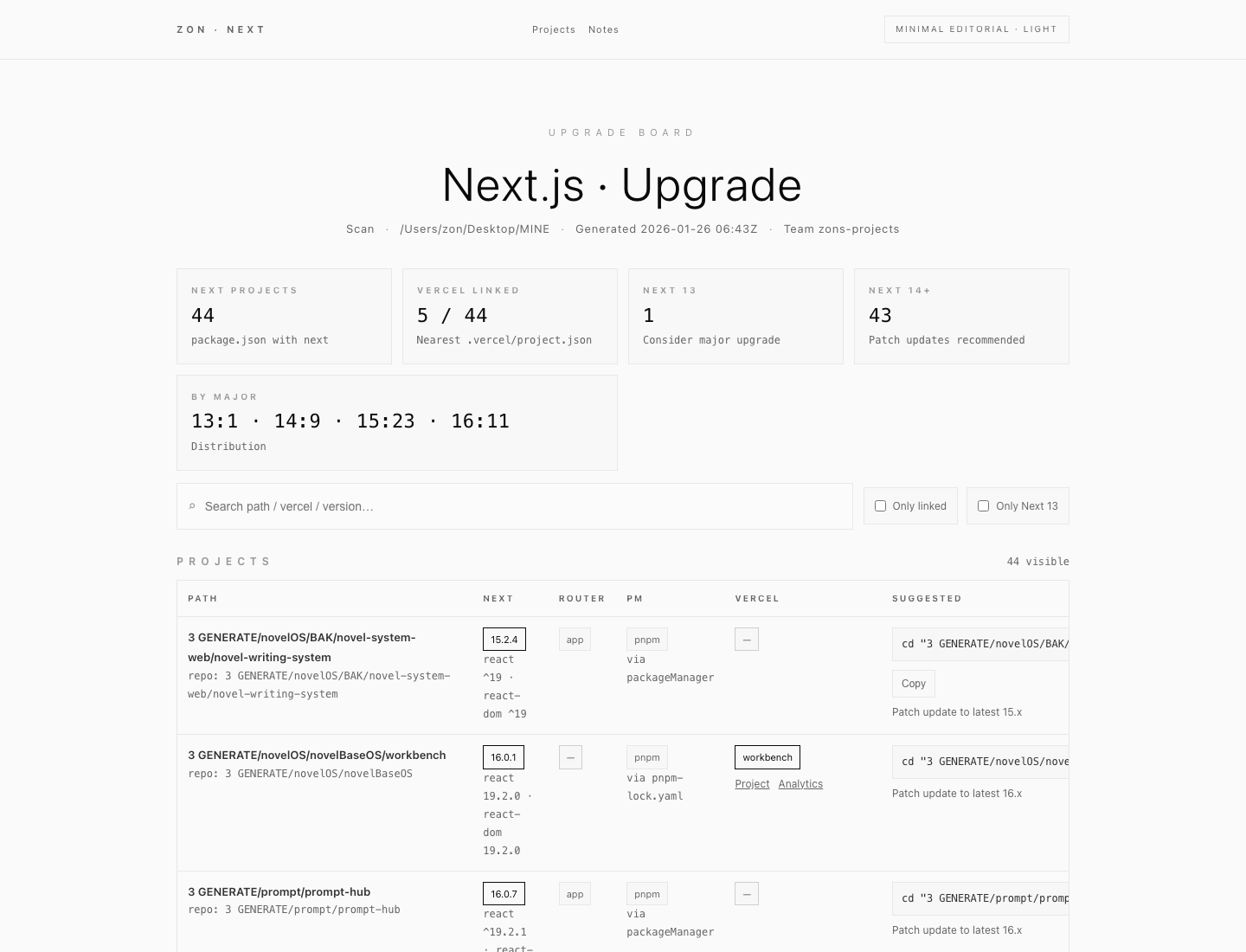
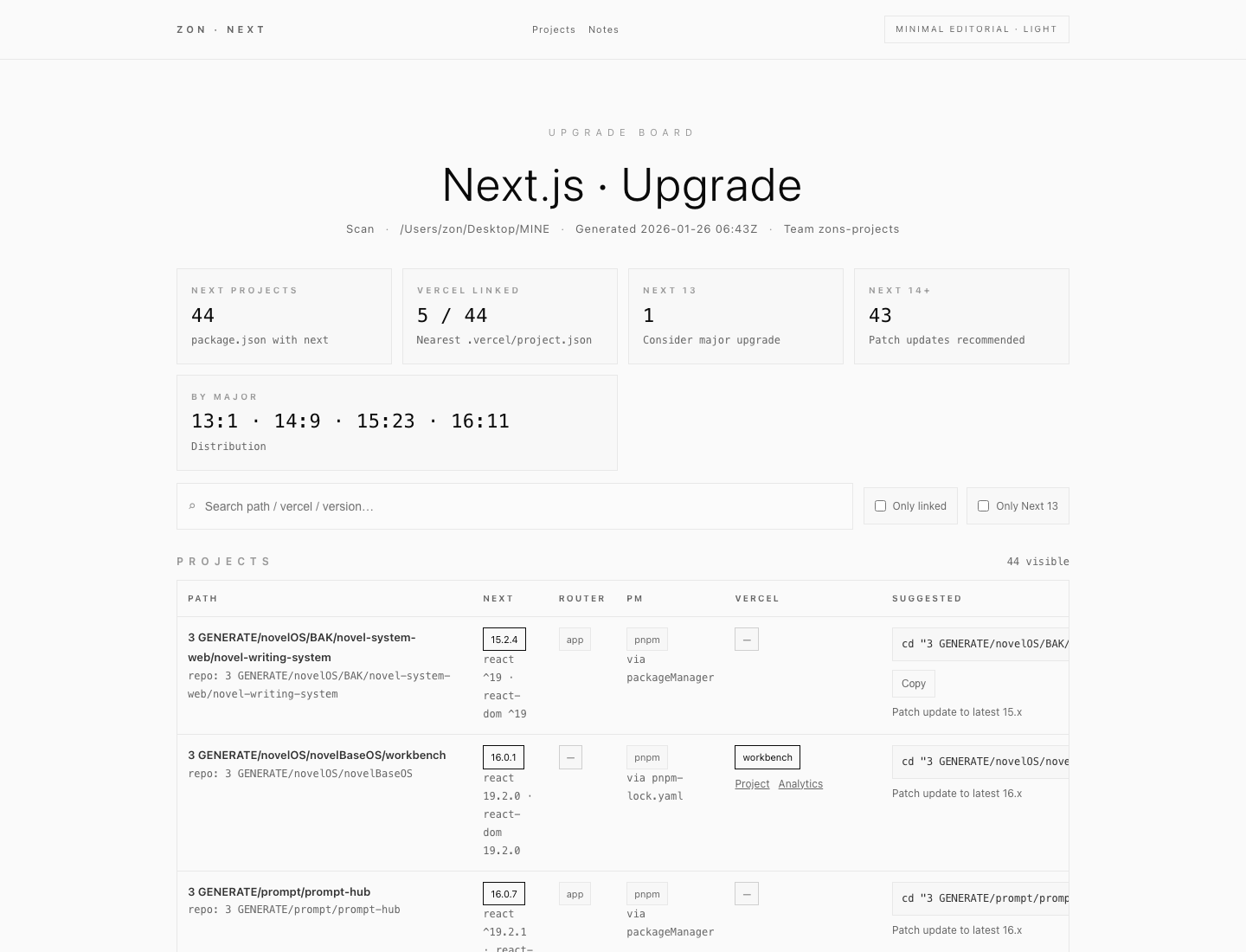
A Next.js upgrade governance board that scans local repositories, summarizes version distribution and Vercel linkage, and outputs executable upgrade commands.
  • Next.js
  • Upgrade
  • Board
  • Monorepo
FeaturedWeb DashboardStatic DemoWebStatic HTMLUpdated 2026-04-04
Next.js Upgrade Board cover

Overview

What shaped the work

Outcome

Results and impact

  • Shifted upgrade triage from repo-by-repo checks to risk- and linkage-driven filtering.
  • Enabled execution teams to copy commands straight from the board.

Decision

Key decisions and tradeoffs

  • Consolidated version spread, Vercel linkage, and upgrade commands in one board.
  • Generated command templates directly from rule logic.

Evidence

Evidence and proof

  • Public static snapshot: /projects/nextupgrade/live.html.
  • Shows version distribution, project-level detail, and linked/high-risk filters.

Visual history

Latest state first, previous interface states preserved underneath

This timeline keeps a readable visual memory of the surface, so the newest cover can stay on the project card without erasing what came before.

Case study

Narrative, decisions, and proof

01

Outcome

Results and impact

  • Shifted upgrade triage from repo-by-repo checks to risk- and linkage-driven filtering.
  • Enabled execution teams to copy commands straight from the board.

02

Decision

Key decisions and tradeoffs

  • Consolidated version spread, Vercel linkage, and upgrade commands in one board.
  • Generated command templates directly from rule logic.

03

Evidence

Evidence and proof

  • Public static snapshot: /projects/nextupgrade/live.html.
  • Shows version distribution, project-level detail, and linked/high-risk filters.

04

Role

Role and contribution

  • Owner / Product Engineer: defined upgrade rules, built scanning pipelines, and shipped an execution-first board.

05

Problem

Problem to solve

  • Parallel repositories create fragmented Next.js versions and opaque deployment linkages, making priorities inconsistent.

06

Constraints

Constraints and boundaries

  • Data comes from local repo scans and must stay lightweight for recurring use.
  • Output has to be actionable, not merely descriptive.

07

Background

Why this exists

With many Next.js repos, upgrades become a portfolio problem: which ones are on older majors, which are linked to Vercel, and what should move first.

08

Scenario

Use scenarios

  • Inventory current Next.js versions across repositories.
  • Identify linked projects that need stronger production-impact review.
  • Generate direct upgrade commands per repository.

09

Delivery

What I shipped

  • Upgrade summary with project count, version spread, and Vercel linkage.
  • Per-project table with path, version, router type, package manager, linkage, and suggested commands.
  • Filters for linked projects and higher-risk upgrades.

10

Design

Design decisions

  • Output must be executable, not audit-only.
  • Show the version distribution first, then drill into per-project action.
  • Keep governance light through a shareable single-page board.

11

Tech

Implementation

  • Scans package.json, lockfiles, and .vercel/project.json for metadata.
  • Renders findings as static HTML for sharing, archiving, and reruns.
  • Rule layer emits command templates to reduce manual copy mistakes.

12

Access

Current access

  • Public site presents a static demo snapshot.
  • Live data ingestion remains local, so public output only shows safe snapshots.

Flow

The path from entry to completion

This project is best read through the product shape itself: screenshots, access boundaries, and the sequence of key tasks explain the experience more clearly than a single static description.

Scan / Classify / Suggest / Upgrade

Next.js Upgrade Board flowScanClassifySuggestUpgrade

Explore

Continue through the material

Next.js Upgrade Board preview

Access

This entry is still part of a living practice. The public surface may be a live URL, a guided preview, or a curated set of interface states depending on the current release shape.